 Carolanne played the role of Dross in the the 2022 Merc Playhouse production of The Nutcracker. Carolanne played the role of Dross in the the 2022 Merc Playhouse production of The Nutcracker. We shine our Merc spotlight this month on Carolanne Steinebach, who, along with her late husband Egon, founded our beloved community theater twenty-five years ago. Both Steinebachs had a rich history with all things theater, as well as a loving two-decade familiarity with our valley, so on a visit, when they stepped into the then-Mercantile Store, they recognized at once the excellent natural acoustics of the place. The building went for sale; the couple made arrangements, and by 1999, Twisp could boast its own theater.
Carolanne traces her deep love of theater to a childhood where she and her brother and sister indulged imaginative play centered around a costume box from which kings and princesses and little Dutch girls emerged. Carolanne can name the plays she took part in during grade school, year by year. Years later, while living in Vancouver, she enrolled in theater school; the instructors accepted her reluctantly — their first student over the age of twenty-five — but soon recognized the wisdom of working with an experienced adult who had no professional aspirations. The Merc Playhouse applauds one of our most ardent supporters. Carolanne has acted, directed, and instructed; she supports us with her attendance, serves on the Play Reading Committee, and is a loyal Friend of the Merc. We are honored to have our founder with us today in such active roles. . 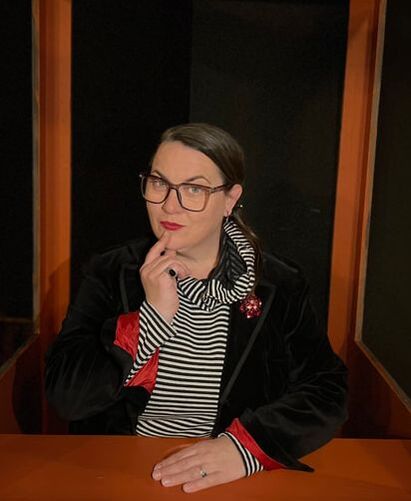 By Kira Wood-Cramer
This month’s spotlight shines on Emily Doran, The Merc Playhouse House Manager for the last five years, with a COVID interruption. She has also been a volunteer, a board member, prop master, costume designer, window dresser, cake cutter, box office, and concessionaire extraordinaire for 15 lovely years. Why is live theater important in a small community like the Methow Valley? When Emily moved here with her family 15 years ago she called The Merc and said, “I'm new in town, what can I do?” Julie Wenzel was working on the children's show Robin Hood at the time and she asked if I could sew? Emily said “kind of, but my sister-in-law Lisa can and off they went making little elastic waisted britches and pirate shirts on Grandma Doran's sewing machine. From that point on, whether it was on stage or backstage, Emily has been involved in almost every show at The Merc. “Since being in the Methow Valley for the last 15 years I’ve seen a lot of people have the same beautiful experience as I have had at The Merc. I have especially loved watching the children's productions come together. All the rehearsals, dances danced, songs sung, diva moments and hard work comes together, and it's been a joy and a privilege to witness how proud these kids are of themselves and each other. Their confidence grows with every show and that's what it's all about. These kind of creative experiences are vital in a small town, not just for children but for people of all ages. Especially during the long winter months, we are compelled to come together and create something beautiful entertain each other. Performing arts are unique because it can be framed, sculpted, or captured. Even if it only lasts for a moment on stage, it will live in on your heart and mind forever.” Past experience with theater: Emily’s moms is a theater nerd and her dad is a band geek, so she grew up in a musical and theatrical household. Her mom was a bit of a stage mom, and had Emily enrolled in piano lessons, ballet, tap, and jazz dancing. She encouraged Emily to sing Christmas carols while she played piano, slowly but joyfully, when she was growing up in Clatskanie, Oregon. There was a music shop and VHS rental place in town called Victor’s Music. Mrs. Victor taught lessons on every instrument and would put on plays in town to showcase the local talent. “My dad would be in the band in the orchestra pit, and my sister and I would be up on stage. I think the first show that I did for Mrs. Victor was called ‘Not Just Another Anne’. For one musical number I played Anne Boleyn and my sister was little princess Elizabeth. I was probably in about third grade, dressed up in a gorgeous gown and dripping in fake jewels. A friend of mine played Henry the Eighth and sang ‘I’m Henry the 8th, I am’ and when he was done, the executioner came on the stage and escorted my sister and I offstage to our doom. I didn’t have one line, but a star was born.” What excites you about live theater? I love the absolute crazy, controlled chaos of theater. Anything can happen, and that fact is very exhilarating and absolutely terrifying. You have to trust others and trust yourself and the collaborative process. It’s quite a powerful moment when you're all working as a team and people are laughing, or very quiet, you know that you're reaching them. Feeling that energy exchange from performer to audience member is pure elation. I highly recommend it, Can you share a unique experience you have had in a theater setting? Golly, I don't even know where to start because there are so many, but probably the time The Merc backstage flooded during ‘The Book of Liz’ could be considered a unique experience. I mean, in hindsight the show probably shouldn't have gone on, but it's how we do at The Merc — The show MUST go on! Favorite show? (Of all time, and at The Merc) Evita - Emily’s mom took her to a performance of Evita when she was a self-proclaimed bratty teenager. The performance brought tears to her eyes, even when recalling the show to me over lunch. There was a moment in the show that inspired her greatly, and we are so grateful for the fire that was lit in her theatrical heart. It's a Wonderful Life was Emily’s first onstage production at The Merc, and she played the role of the mean bank examiner Ms. Carter. Not only did I have the time of my life, but I met some of my dearest friends in the valley, my tribe. Lady Jane Pappitas as Clarence the angel? Still one of my favorite performances ever on our stage. Looking out during the curtain call and seeing our beautiful town on its feet cheering, it was magical to be a part of.” Having Emily on our Merc team has been an absolute delight. My first encounter with Emily was at The Merc, when she costumed me for our children’s theater production of The Hobbit. I will never forget fighting with her in the dressing room over the large green nose that she gave me for my character (The Goblin King) in The Hobbit. At 14, it was not the best look. Emily gave me the confidence to commit to my character and step onto the stage with that monstrosity, and I will forever be grateful for that alongside all of the other lessons that I’ve learned from our brilliant House Manager. I would say we will miss you, but I know that you will always be here. Though Emily has decided to step away from her role as House Manager, she will always have a home at The Merc. Thank you for all that you have done to keep the show going. -Kira 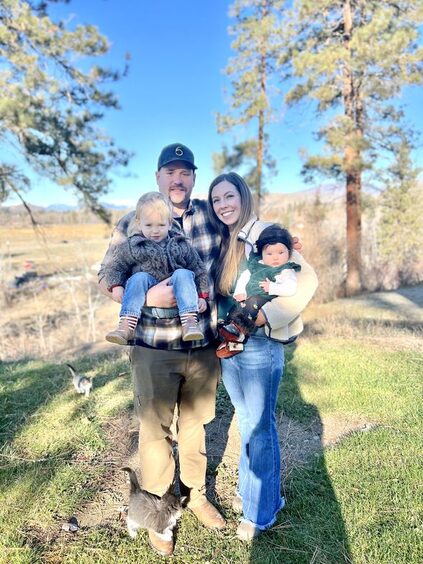 “I’m so impressed that a community this size has thriving live theater. I never dreamed I could follow my passion without living in a big city.”
The Merc Theater’s new Technical Director Karter Deane is thrilled to practice her craft right here in the Methow Valley. She expected she would have to live in a big city for that dream to come true. She’s not the only one who is thrilled. The Merc lucked out to have such a qualified person living locally to fill the position. Karter attended college in Colorado and graduated with a Bachelor’s Degree in Fine Arts with a focus in Technical Theater. Her training and experience includes all aspects of live theater from set design, lighting, acting and directing. “Collaborating with people in different roles is what makes the work interesting”, she said. She performed in several productions in high school including, Little Shop of Horrors, Joseph and the Amazing Technicolor Dreamcoat and MIdsummer Night’s Dream to mention a few. In college her focus shifted toward the tech side of theater. Karter’s life experiences have given her exposure to a wide range of people and rich adventures. She worked seven seasons on an Alaskan fishing boat where she met her husband Elliott Layfield (who graduated from Liberty Bell High School). They moved from Anacortes to the Methow Valley to raise their young family which includes their two-year old son Ridge and eight-month old daughter Ryett. Along with being a wife and mother, Karter has a diverse work history in the service industry, construction trades, painting and recently working for a CPA during tax season. She still finds time to sing karaoke and make music a big part of her children’s life. Karter is looking forward to more community involvement. She is especially excited to work with Liberty Bell High School drama students to help grow the program and to teach students the tech side of theater. “Theater is a cool way to bring all types of people together to work on one project to create something”, she said. Next time you are sitting in the darkened theater and the performance is enhanced with a sound effect or special lighting, think about Karter. She is an important part of creating the magic that is live theater!! 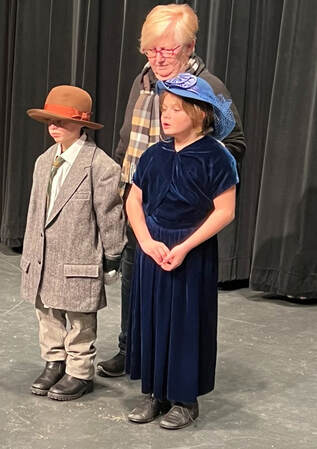 As primarily a children's director, what benefits do you think the kids gain at The Merc?
Children walk into The Merc ready to work hard and totally commit themselves to telling a magical story. I know that because they tell us they love every moment of the experience. The Merc provides opportunities for them to expand their imagination and creativity as well as their confidence and self-awareness. They love the idea of telling stories to audiences in the best way possible. When they’re not on stage, they find ways of developing friendships with others. I watch actors play games with a sort of sign language when they are backstage and having to wait silently for the show to start. And I love that! Cast members of any show can create bonds with each other. It seems to always happen at The Merc. The actors work together for a long time and become a team. They learn each other’s lines, and I am assured that they’re ready to cover for each other on stage if need be. The live performances, the interaction of the cast, and the palpable energy in The Merc all contribute to creating an unforgettable experience for the actors. What was your first theatrical experience? In 8th grade, I was in a school talent show, and I sang “Modern Major General” from The Pirates of Penzance. My costume, resized for me, had been my father’s Mardi Gras costume, all glitter and satin with rhinestones and epaulets. It was the first and last time I performed on stage, primarily because I couldn’t carry a tune even though I thought I could at the time. I like directing much more. What was your original connection to the Merc? Before I directed for The Merc, I was the junior high/high school drama teacher/director for many years, and often produced/directed shows at The Merc. The last two before I “retired” were Treasure Island and The Two Gentlemen of Verona. Both hold sweet and enduring memories for several reasons. Which play that you’ve directed was the greatest challenge, and why? I was asked to direct The Miss Firecracker Contest by Beth Henley in 2017. Instead of having auditions, I precast it mostly with teachers I worked with and friends. Some were seasoned actors but others were not. We had about two and a half months of rehearsal and when we were off script, one of the actors couldn’t remember any of her lines no matter what. By the time we were close to opening night, I had moved her into my house, so I could keep her from dropping out at the last minute. We ran her lines for what seemed like hundreds of times but she still couldn’t come up with anything. At this point we were opening, so I bought a fashion magazine and glued her lines on various pages. The audience saw a character thumbing through a magazine during dialogue with another actor, but in reality she was accessing her lines. When she wasn’t on the couch looking through the magazine, I put her lines near her props– the telephone, bouquet of flowers and the makeup case. No one ever knew it, and she was fabulous, but it was very distressing to me as you can imagine, because it was the first full length adult show I’d ever directed. Which play was the greatest ease, and why? I’m not sure any show is easy, but Fantastic Mr. Fox was easier than most, and I believe most rewarding. It was the show that was sadly shut down the day of dress rehearsal because of COVID. Then two years later, the set and costumes were ready, and about half of the cast came back. It was a terrific cast with lots of heart. There was much to celebrate. Do you have a dream role or show to direct? I have a dream show, either directed by me or someone else. It’s To Kill a Mockingbird, a new adaptation written by Aaron Sorkin, and one I recently saw on tour. I have always loved the book. I grew up not far from Harper Lee’s hometown, so I have some connection to that world. Any final thoughts? Yes, I must say we are so fortunate to have The Merc Playhouse in our community. It is indeed a “community theater.” Our audiences are so supportive, and volunteers and donors never waiver. Our board is hard-working, and the staff gives it their all. Everyone is present, helping when we need anything. I’m directing James and the Giant Peach, and I am so grateful to the number of businesses and volunteers who are helping us put on this show. I know we couldn’t do it without our community who love this little theater as much as the people who work in it. 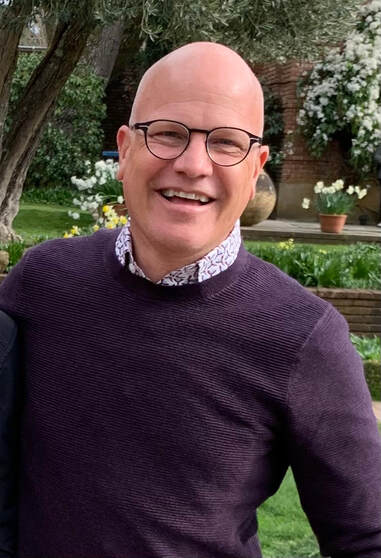 By Amanda Fine
Our spotlight this month is aimed at Don Linnertz, Don Linnertz and his husband Scott Wallace are community advocates, generous donors, and passionate patrons of the arts. When they moved to the Methow Valley and became “Friends of the Merc” they knew they were in for a fun season of theater, but they had no idea how involved they would become “outside the building” working with many others to secure broad support for the arts in our community. I caught up with Don for a coffee at Blue Star Coffee Roasters in Twisp recently to learn a bit more about his “we are all in this together” experience supporting The Merc Playhouse to be the best it can be. What was the first show that you attended at The Merc Playhouse? You know, I can’t remember. We moved to the valley full time in June of 2014. That was the summer of the Carlton Complex fires; shows were canceled, the doors at the Merc — like many others — were closed. Although disappointing I’m sure, it sounded like landing in the Methow Valley in the summer of 2014 only intensified Don’s and Scott’s intentions to be active members of the community and involved wherever they could contribute. Soon Don’s “we can go farther faster together” mantra was a part of collaborative efforts across the valley. When did you first become involved at the Merc? We did start with season tickets and enjoyed going to every show, sitting in our reserved seats! [a practice that is no longer an option at the Merc] But I really got involved when I stepped in as the interim, and then full time, Executive Director at TwispWorks. Until I retired from the position in 2021, I loved being a part of the “XD’s”, an informal group of arts directors in the valley including the Merc’s Executive Director at the time, Missi Smith. We shared concerns about realities in the valley like housing needs, and imagined a future where we could do even more for our community if we used talent efficiently and pushed hard for collaboration. The establishment of a Creative District in Twisp was one of the outcomes that emerged from that time. Don then told me a funny story about former Merc Board Chair and children’s show director, Jane Orme, who invited Don and Scott to an “open house” at the Merc one evening. They arrived to learn they were auditioning for a play! Don dutifully read the parts (Scott passed!) but they did not take the bait. Scott volunteered to come back to the Merc and clean up all the cobwebs he saw in the rafters that evening. To this day Don has resisted reviving his North Dakota childhood acting career (as Ebenezer Scrooge in A Christmas Carol in elementary school, and as Peter in a high school production of Heidi) on The Merc’s stage. What have you enjoyed the most about your involvement with The Merc? I love the sense of community coming together at the Merc. There are not many places you get to see people you know on stage. You witness them transform and we all break free from who we are in our everyday lives. What do you think is unique about The Merc? I was able to meet, and many of us know, the Merc Playhouse founders Egon (before his death) & Carolanne Steinebach, which is very special. I have fond memories of times at the Merc that are linked to non-theater events like a Valentine’s concert of the Methow Valley Chamber Music Festival or a reading of The Last Salmon by author Phil Davis. I do not know other theaters that do that — that open their doors so wide. The space is well used and that definitely helps build community. If you had a crystal ball what would you predict is in The Merc’s future? What would you hope for? I would love to get to the point where the team at the Merc can focus all of their energy on putting on the next best play without worrying about a leaking roof or backstage plumbing. The pandemic was a shock to the collective system, but it also reminded us how important community theaters like The Merc are to all of us who call this place home and to the future of Twisp and the Methow Valley as a destination. I hope we find a shared vision and really go for it together, so we continue to have a performing arts center that serves the Creative District and each and every one of us. If you met someone who has never supported theater or experienced live theater, what would you say to entice them or sell them on the idea? I would invite them to a show. I would say “come in and see the magic”. You will see a broad swath of our community — we have all landed here. Don’s answer made me think about supporting The Merc. Walking through the door is really all it takes and everyone is welcome. For live theater, the audience is as important as the actors on stage. By putting your hands together at the end of a show, or adding your energy to the room, you are part of the performance. What The Merc pulls off with the support of an army of volunteers (including the actors), a talented and dedicated skeleton team of staff, and a community that loves this spot truly is magic. When will we next see you at the Merc? We loved The Half-Life of Marie Curie directed by Carolanne Steinebach, and isn’t James and the Giant Peach coming right up? I heard about the play from one of our youngest community members who is in the cast. She popped her head out of her mom’s car to tell me not only about the epic giant peach, but also that she and all the other kids in the play are dead! How can one stay away after an endorsement like that? We are looking forward to seeing Don and Scott and all of YOU at the next event at the Merc. Come out and enjoy a bit of live theater, be a part of this fun community, and help in any way you can. Every bit counts and it is all appreciated. 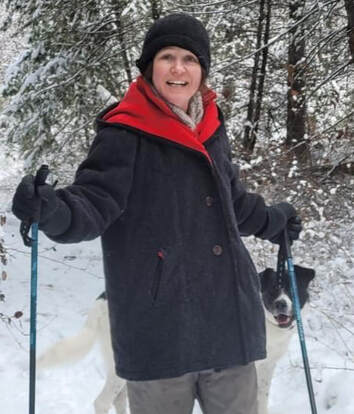 Interviewed by Phil Quevillon Our spotlight this month is aimed at Kristin McFadyen, a familiar face behind the concessions counter during productions. Kristin is the owner-operator of Yo Dog Pet Grooming in Twisp. A former resident of Illinois, Kristin joined the Methow Valley community on September 2, 2010 and was the catalyst that later brought her father, mother, and later her best friend and Merc board member Phil Quevillon to our slice of paradise. I asked Kristin what she thought about volunteering and attending shows at The Merc. What was the first show that you attended at the Merc Playhouse? It must have been Proof. I believe Donald McLaine was one of the actors. When did you first become involved volunteering at the Merc? Probably back then or after I stopped working at Sunny Pine, so two years after I moved here, which would be about 12 years ago. You have volunteered in many spots at the Merc, including the tech booth, concessions and backstage. What have you enjoyed doing the most? I think a mixture of volunteer jobs. I like mostly working behind the scenes; however, I do like running concessions. While working at the counter, you have opportunities to hear and see audience members talking about the play, but when you’re behind the scenes, such as backstage as a stagehand or other position, you get kind of a secret backstage view of all the nervous actors before and after they are on stage. I think both volunteer positions are fun. If you met someone that had never been to theater or experienced live theater, what would you say to entice them or sell them on the idea of buying a ticket and being part of an audience? It’s real people, real community people expressing and doing an art form that they feel pulled towards. I think that seeing any kind of creativity with people is good even if it’s bad. KristIn, I’ve been interviewing you while you’ve been washing a bulldog. What's the Bulldog’s name? His name is Douglas. Douglas, do you have any thoughts on live theater? (nervous) Thank you thank you for the belly rubs (heavy panting) And we thank Kristin for stepping into The Merc and being part of our volunteer community.  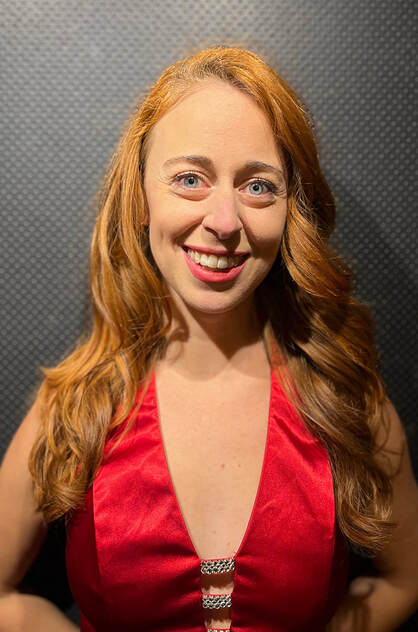 This month, we are pleased to spotlight Jamie Petitto, aka Miss Scarlet in Clue. Jamie also serves as our trailer videographer extraordinaire and prior to Clue, has found her way to our stage in The One Act Play That Goes Wrong and Diner on the Way (2019). In addition, Jamie volunteers on our Programming Committee that reads scripts for the next season’s shows.
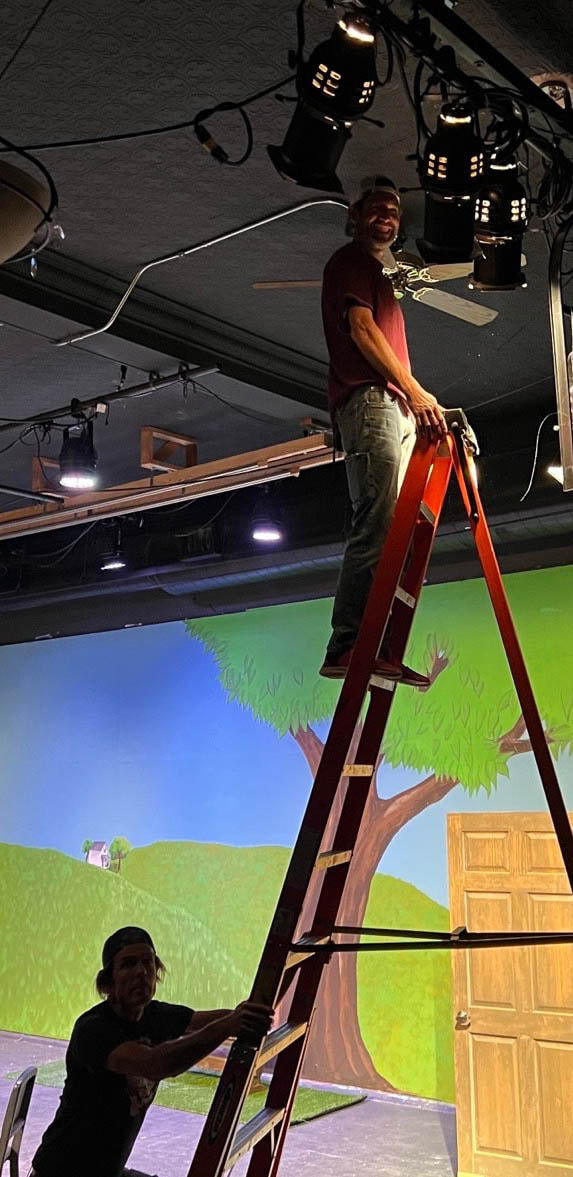
Recently, Jamie and board member Jim Ditto met up on the banks of the Twisp River. As the rushing water provided background, they talked middle names (she won’t tell you hers), favorite dinosaurs (brontosaurus), theater, acting for pay, acting on camera, and what makes people laugh. Q. Tell us about your past experience with theater? After booking the role of narrator in Stone Soup in second grade and watching everyone stare at me and tell me how good I was because I could read [STILL TRUE] and I had a cute hat, I knew that’s what I wanted to do forever. And so in my junior year of high school, I decided to audition for Romeo and Juliet. I thought I could get Juliet. I got the nurse, which makes sense now — the comedic relief. Because of auditioning and booking, I was demoted from the varsity soccer team to JV because they said I couldn’t do both. So they called me Big Mama because that’s the year that Chicago came out — the musical with Queen Latifa as Big Mama — because I was the only junior on the JV team. It was all freshmen and sophomores, then me. I just always realized that being in theater was going to be a sacrifice and not my profession because I liked doing too many things. It wouldn't be my college major — it didn't seem practical and I never considered it a career — acting or theater. I just thought theater was a way to hang out with people who were like me, and I almost always did comedies. Even as the nurse, I was doing Shakespearean comedy. What excites you about live theater? Even if you say the same words, in the same order, for the same amount of time, every night, seven days a week, you’re still going to have a different show because there are different people, with different reactions, and they’re bringing different concepts and realities and expectations to the table. It changes you on stage, whether you realize that or not. I like that you feel differently, even if you’re saying the same thing over and over again. I’ve never had such a monotonous variance in all my life. Heh heh heh. It’s addicting. It’s like “What are we having for dinner?” And you’re like, “Chicken.” And you’re like, “I don’t know why it tastes different tonight. It just tastes different tonight.” Tonight’s lemon chicken because the audience brought lemon that night. It’s garlic chicken because the audience brought garlic. The audience brings the seasoning to an entree that is the same. Same entree, different seasonings every night. Plus you never know. It’s not safe! You could, at any point… Isn’t everyone’s nightmare if they’re in acting, that they’re on stage and they can’t remember their line? Haven’t you had that dream? That you were on stage and you were just given the script? That you haven’t had time to prepare… So to go on stage, that’s still an option. It’s back there in your subconscious and you’re like, “I could say whatever I want and sabotage this. Someone in the audience could stand up and sabotage this.” I guess I like that you show up and we’re all on the same page, that we’re all going to be supportive and we’re all going to have fun. And they’re ROOTING for you! Why do you think it’s important for the Methow Valley to have live theater? When you live in the Methow Valley, I think you share a set of experiences that all relate to one another. You all know what it’s like to maybe garden or to recreate outside. Or you’re all going to the same restaurants because there’s a handful… So you can relate to all of these people all of the time. You’re going to the same events. And if you love theater, then we can bring in stories that aren’t the Methow. They’re in a second story apartment in New York City. They are in Namibia. They are underwater. They are… you know? And I imagine most of the material we bring, even if it’s The Wizard of Oz, that the Methow hasn’t experienced and this allows them to go to the same restaurants or your same riverside hole and have your mind expand and and come up with a friend that you’ve seen every day for thirty years and having maybe a new opinion on something, a place, or experience you haven’t thought about before. Live theater brings this novel concept to your mind, even if your body does the same thing on repeat in this valley, that you can relate to. I like that actors are leading the audiences into a new expansive world that’s different in their mind. Live theater in the Methow allows people to think about other things. It’s a way of traveling, like the Armchair Traveller. I think, maybe it’s just projecting because I like traveling, but I think getting someone to sit in a seat and have their mind travel elsewhere is actually a healthy thing to do, whether it’s to appreciate this local area more, or as much, or whether it inspires them to get out, for a second, of this small community and then come back? I don’t know. I think that there’s something charming about community theater. It’s people doing it because they just really enjoy telling a story. And they’re just like, “Hey, sit back,” And they’ll just go around the fire — except it’s a theater. It’s a story. “The Merc loves the stories Jamie tells as an actor and a videographer. Thank you Jamie, for sharing your insights as well as your stories and inspiration!” 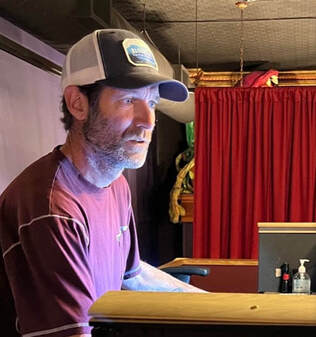 Our spotlight this month is our very own Mike Doran, past and present Technical Director. The Technical Director is more than essential to the production of any show on our stage. Mike’s a homegrown boy from Twisp. Here’s what he has to say about how he got to where he is today: Describe yourself — where you grew up, family, education, etc. I was born and raised in Twisp. My parents are Dan and Chrissy Doran, and I’m the middle of three kids. My older brother is Ken and my younger sister Lisa Doran Marshall. I graduated from LBHS in ’93 and went on to join the Navy and train to become a hull technician aboard the USS Anzio. I served in the first Gulf War/ Operation Desert Storm and did a tour in the Mediterranean and Adriatic, traveling throughout Europe and the Middle East. I started my first construction business after I left the Navy and moved to Seattle. I also was in several bands and started a recording studio with my bandmate Ira Wilks during that time. I built up most of the skills that inform my work at The Merc by learning audio engineering with that early recording work. While looking for a new project, I answered an ad for a drummer in The Stranger magazine and joined a band that led to me meeting my wife, Emily McDonald, and we were married in 2005. I attended Shoreline Community College, studying computer networking and repair, which helped with the early digital recording days where computers and recording gear never played well together. Emily and I bought our first house and welcomed our first son Evan in 2008. In 2009, my father Dan was building a house and asked if I could come help him with the construction. We arrived in the valley thinking we’d only stay for a year or so. We have now been here 13 years and have added another son to the family, Nathan in 2013. Currently, I’m working as Interim Technical Director at the Merc, in addition to running a tiling business. Tell about how you got involved in The Merc. What responsibilities did you have? What responsibilities do you have now as an interim TD? When we first moved back to the valley, Emily was a new mom staying home with Evan and wanted to reconnect with her theater roots. She emailed Julie Wenzel and volunteered at the Merc, sewing costumes with Lisa for Robin Hood and then eventually auditioning for shows. Soon she became a board member and was part of the Capital Campaign to purchase the building from Egon and Carolanne Steinebach. Upon Egon’s retirement from tech duties, The Merc was looking for a new technical director. Based on my prior credentials and education, Emily offered up my name as a prospective candidate. I was eventually brought on as an employee and after a few years, I left The Merc to build another house and pursue electrical training. I recently came back as an interim technical director in addition to my other gig– installing tile, and playing drums in my band Black Pine, with Andrew Tuller, Bill Bartel and Nick Sabalewski. My duties were and are to program lights and sound for Merc productions and rentals. I work closely with directors to build light and sound scenes. A big part of my job is directing strikes, which include the final breakdown and reset after a show. I also keep the gear working properly, research, and advise in purchasing gear as needed and report to the board of directors monthly. Can you think of a particular memory of working as the TD in the past? Something surprising? Funny? From a tech perspective, my favorite show to help create lights and sounds was Venus in Fur. It was a very technically flashy and light-effect heavy show. So, I was at the Merc finishing up some stuff, and I had to run and grab something from the office. I walked in, as I normally would, and our ED Missi was standing there in head-to-toe lingerie. Red-faced, I bolted out of the office, apologizing profusely to her for walking in on her while she was changing into her costume when she stopped me, laughed, and told me, this IS the costume. To this day I’m never shocked by what I see around a corner at The Merc. It could be a dragon, it could be Mr. Peanut, or it could be your boss in lingerie. You just never know with theater. In general, why do you think live theater is important in a small community like the Methow Valley? Theater brings people together to share stories, experiences and culture. It provides creative outlets for people in rural places and gives them a real connectivity to the community. As a drummer, I’ve always enjoyed making music and being with a group of creative people and performing. There is so much talent in the Methow, with so many great bands and shows happening all the time, and that’s how it’s always been out here. In the valley, we all come together to entertain each other when the weather gets cold and the snow gets deep. Without the performing arts, cabin fever can take hold, and if you’re not into outdoor winter activities, The Merc provides something completely different to do instead.
 Missi Smith leads the audience in a dance after a children's theater school-day performance of Rikki Tikki Tavi. 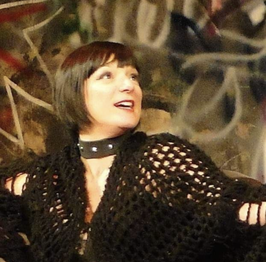 Missi Smith in Venus in Fur. Missi Smith in Venus in Fur. Our September Spotlight shines brightly on Missi Smith, who came to the Merc with big shoes to fill as Executive Director (ED) nine years ago. Not only did she fill them, but she made them stilettos and strutted them all over the theater. We have had the privilege to experience her as an actor, director, choreographer, and fearless leader of the Merc Playhouse. She has since retired as ED but continues to volunteer her time in a variety of ways. The Merc is forever changed through her contributions as she truly is our unicorn. Missi explains her journey within the theater here in her own words:
Tell us about your past experience with theater. I grew up dancing and that is how I spent most of my youth, teens, and young adult life on stage. During my early years, I was a child dancer in the Indianapolis Ballet Theatre's annual Nutcracker performances several years in a row. I toured with the ballet company and really loved everything about it. I was also a dance competition kid. As I grew older, I performed in musical theater productions, theme park and mall-type shows, and I danced in the contemporary dance company in college. As a side gig, I choreographed and taught dance classes. I have been involved in performing arts of many types ever since. It wasn't until I moved to the Methow, and got involved in theater here, that I had experience with "straight plays." That was a whole new challenge! But it's gone well, and it's become another love of mine. I joined The Merc board several years before I wound up in the Executive Director position that I held for eight years. What excites you about live theater? Oh man, as an audience member, or as a cast member, or as a director? It excites me in many different ways. As an audience member, I come to the theater with a lot of wonder. How will I be transported to another world or reality? What will I witness, and what will I learn? How will I think and feel differently once I've experienced this live performance? As an audience member, I honor all of the work that goes into creating live theater and I am here to witness! As a cast member? Well, the excitement of presenting something in front of a live audience is unparalleled. I mean, maybe you can compare it to other thrill-seeking adventures, but I'm typically risk-averse. I'm not somebody who goes fast and hard down a mountain...but I know a good adrenaline rush, and there is nothing like the 5 minutes before a performer takes the stage. It is a total "be here now" experience to dive into a character different from your own, live in her skin for 90 minutes, and tell a story to an audience of people. Then there is the director or choreographer role that I find much fulfillment in. I thoroughly enjoy the challenge of creatively telling a story through live theater. It's a longer-seeming endeavor because in those roles, I begin planning and charting the course long before I even know who is in the cast. It's a slower burn to opening night, but the thrilling part comes when I no longer have any control over the show and the actors have fully taken on my vision and sent that out to the audience. Sometimes, when I've directed or choreographed a show, my favorite thing to do is watch the audience from our secret perch up in the mezzanine. I get a thrill out of seeing the audience's reactions. Why is it important in a small community like the Methow Valley? Live theater is a wonderful teacher and community builder. The Merc provides a place for people of any age to learn new skills, be part of a team (or family as we like to call it here), and to explore sometimes difficult concepts. It brings people together. I mean, we sometimes have 8 year-olds in shows with 80 year-olds. They work together to create a final product and during that time they all learn from each other. I don't think that happens in many places besides the theater. I could go on and on about skills and traits theater teaches that one doesn't learn in school or classes: Confidence, dedication, discipline, communication, using one's voice, etc... Then, there are the benefits an audience experiences. Being together to witness members of the community perform and entertain is so valuable. It creates memories. People still remember that one time something amazing happened on The Merc stage and they were there to see it. They talk about shows we've done that open up conversations about history, politics, and the condition of being human. Live theater is an asset and it greatly enriches lives, and I am so grateful that the people in the Methow know this and support us! Can you share a unique experience you have had in a theater setting… As an actor or director? Hahaha, every experience is unique; that's what makes it so fun. But. BUT. There was nothing quite like my experience onstage in Venus in Fur. I talk about it way too much. I'm sort of like, "One time at bandcamp..." Do people get that reference? haahaha. But that role really was exceptional and a great challenge with seismic rewards. Other unique experiences tend to be the outtakes that nobody actually sees from the audience. The times s*** goes down backstage or during the rehearsal process and everyone has to overcome it together and it all works out in the end. Those are the secrets of the magic of theater. You gotta come be in a show to know what I'm talking about. It happens every time, it seems like, and every time it's different and every time we make magic. What draws you to a particular script? I like scripts that contain real people grappling with real-life issues. I like stories that show the complexity of life and provide characters that actors can really get into and feel something while they are creating. I'm not as into the neatly tied-up, happy endings as much as I am the ones that leave open-endedness. That's how life is, so I like to get into the gray areas and explore both the things that make us laugh and make us cry, or make us want to cry so much that the only thing to do is laugh. Dark comedy? But I know that not everyone likes that, so I also, as the ED, was always looking for a balance. I can also be drawn to scripts and stories that I know make us feel great as an audience (especially for children's shows). The most important thing in a script, I believe, is the characters. What's there for the actors and how can we bring the people (or in some cases, animals) alive onstage? As a director, what do you hope to accomplish? hmmm. I could answer this in a number of ways. I hope to create an entertaining show that executes a clear vision, of course. I want to tell a story that transports an audience. I hope to impact people's lives positively. I want to cultivate the love of performing arts from the standpoint of my cast. I hope to create relationships that last a lifetime, to add to our theater family. Making art in the theater requires a team, and my biggest hope is that the entire team I've relied upon for each show I've produced is satisfied with their work as much as I am satisfied with my own. I think that shows onstage and is very important. 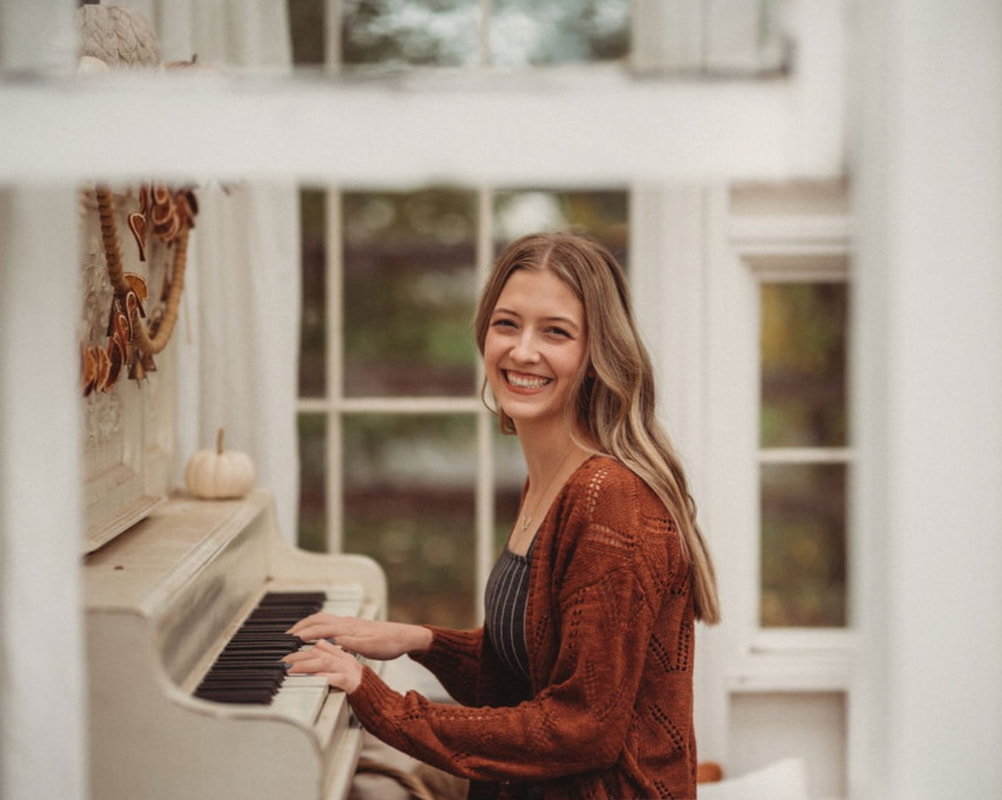 Interview by Kira Cramer
This month’s spotlight shines on Kendal Clifton, our musical director for our summer camp production of The Claw. Kendal worked closely with Megan Hicks for both sessions of campers, teaching them many songs about friendship and conquering fears. Kendal currently attends WSU and is studying Music Education. We are grateful to her for spending two weeks of her summer at The Merc with our young actors. Kendal and I found some time during rehearsals to talk about her theater experiences. Our conversation follows: Tell us about your past experience with theater. Kendal has been performing in plays and musicals from 3rd grade on, and she’s 19 now. She has been cast in ensemble and lead roles in musical and non-musical productions. Some of Kendal’s favorite roles are The Cat in The Hat, Seussical and as Maria in The Sound of Music. What excites you about live theater? Kendal shares that she is excited about participating in live theater because it is unique – much different from a movie-musical. While film production often has multiple takes, live theater is intimate; no matter what character you play, someone in the audience will make a connection. As an actor, she says that she enjoys portraying a character totally unlike who she is. Why is live theater important in a small community like the Methow Valley? Kendal doesn’t come from a super small community, but she believes that live theater gives everyone something to participate in. She says that it’s a way for kids to understand what a community can be, and that theater doesn’t always have to be competitive or like Broadway. Kendal continues that live theater is an important building block that helps community members, young and older, know each other in ways different from just knowing each other in a small community. Can you share a unique experience you have had in a theater setting… As an actor or director? Kendal responded that in junior high, she was the understudy for Peter Pan and had no idea what it was going to entail. She learned a lot when she shadowed the actor who was playing Peter Pan (she was cast as one of the Lost Boys.) The part taught her that it’s okay not to be the lead because she realized that everyone gets a turn and the role you are cast in is usually what’s best for you and the show. Kendal also shared that she choreographed the dances for Seussical with her friends in high school, noting that it was fun to be behind the scenes as well as on the stage. Kendal highly recommends getting some experience in any aspect of theater–on stage as well as backstage – because working in multiple areas of the theater teaches a variety of skills and helps you gain appreciation for all that goes into a production. What draws you to a particular script like The Claw? Kendal commented that she did not expect The Claw to address as many topics as it does. She noted the complexities of emotions in the music–friendship and navigating life choices, which can teach the actors as well as audience members valuable life lessons that she hopes stick with them. She comments further that good theater has something that everyone can relate to, and if she were to choose a script for a children’s show, it would definitely be uplifting. In a good script, she says, struggle is necessary so that there is a positive resolution. Kendal says that music is most important to her – she is a musician first and a thespian second. Music, she says, always amplifies the story. As a director, what do you hope to accomplish? Kendal’s first goal is for the kids to have a good time. It should be fun, they should feel safe, and learn something. Whether they pursue music or theater, it is a great experience to express yourself and work on a team. Sports are more pressure, but theater allows you to be yourself with less confinement. Kendal hopes the actors leave the camp with a sense of accomplishment, and if they get the message from the show, that’s great. If they have the songs stuck in their head, it might become their motto and that is powerful – “it’s the best day…” Anything else you would like to share? Kendal shares that The Merc Playhouse could be in a much bigger city and do just as well because of the quality of performance and talent. She further states that the Methow Valley community is so powerful with auditions happening during the week of camp. She loves that everyone seems to know and help each other out. Kendal also stated how amazing Megan Hicks is as a director, actress, dancer, and choreographer; she says that she has learned so much being in her productions and working with her. Kendal continues that Megan has thoroughly inspired her to become a teacher with her passion and creativity, and Kendal hopes to continue participating in theater’s many aspects. We are so fortunate to have Kendal as our Musical Director during camp weeks and hope she will be back to work with our Merc Playhouse campers in the future. |

creating experiences which connect our community to the diverse aspects of live theater
Site Search:
MENU
Thank you to our sponsors!




The Merc Playhouse | 101 S. Glover Street | PO Box 425 | Twisp, WA 98856 | 509.997.7529 | [email protected]
The Merc Playhouse is a registered 501(c)3.
The Merc Playhouse is a registered 501(c)3.